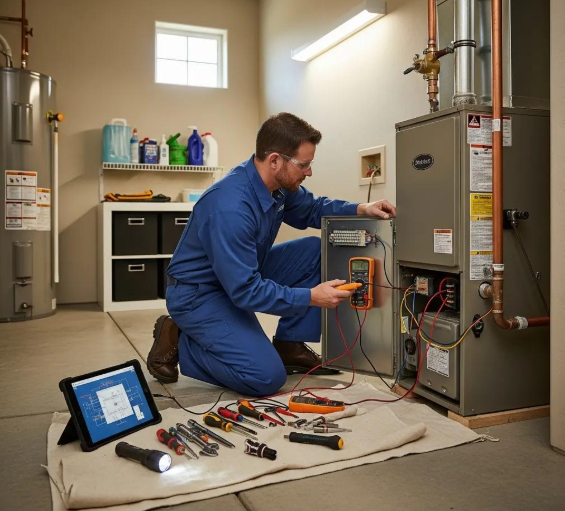
When your furnace starts breaking down, deciding whether to repair it or replace it can be difficult. A simple repair may restore your heating system at a reasonable cost, but an older furnace with recurring problems may require more frequent service and higher repair expenses.
For homeowners in St. Louis, Missouri, making this decision before the coldest winter days arrive can help avoid unexpected heating problems.
The right choice depends on your furnace's age, condition, repair cost, energy performance, and the likelihood of future problems. Here are the key factors to consider before making a decision.
1. How Old Is Your Furnace?
Furnace age is one of the first things to consider when deciding between repair and replacement.
Many conventional furnaces have an expected service life of approximately 15 to 20 years, although actual lifespan varies with equipment quality, installation, maintenance, and operating conditions.
If your furnace is relatively new and has developed an isolated problem, repair may be the more practical option.
If your furnace is approaching or beyond its expected service life and has recurring issues, replacement may be worth considering.
Age alone does not mean a furnace must be replaced. A professional inspection can help determine its remaining condition and whether continued repairs make sense.
2. Are Furnace Repairs Becoming More Frequent?
One repair does not necessarily mean your furnace is failing. However, repeated breakdowns can indicate that important components are wearing out or that an underlying problem has not been resolved.
Consider replacement if you notice:
-
Frequent service calls within a short period.
-
Repeated failures of major components.
-
Recurring heating interruptions during cold weather.
-
Increasing repair costs without lasting results.
Before replacing your furnace, ask an HVAC professional to explain what is failing, why it is happening, and whether the proposed repair is likely to provide a reliable solution.
3. Compare the Cost of Repair With Replacement
Repair costs are an important part of the decision, but the cheapest immediate option is not always the most economical over time.
A relatively inexpensive repair on a well-maintained furnace may provide several more years of service. In contrast, an expensive repair on an aging furnace may not be worthwhile if other major components are also deteriorating.
When comparing options, consider:
-
The total cost of the proposed repair.
-
The age and overall condition of the furnace.
-
The likelihood of additional repairs.
-
The cost of installing a replacement.
-
Expected energy use and future maintenance.
Ask for a written estimate that explains the work involved. If replacement is recommended, compare the total installed cost and equipment specifications rather than looking only at the initial price.
4. Your Energy Bills Keep Increasing
If your heating bills have increased, an aging furnace may be one possible reason. Older equipment can be less efficient than modern systems, but higher bills can also result from colder weather, changing energy prices, poor insulation, air leaks, or thermostat settings.
Look at your energy use over several billing periods and compare similar weather conditions where possible.
If your furnace is old and your energy use remains unusually high, an HVAC professional can assess its condition and explain whether repair, maintenance, or replacement could improve performance.
A newer furnace may reduce energy consumption in some homes, but actual savings depend on the existing equipment, replacement model, installation quality, and household heating needs.
5. Your Home Has Uneven Heating
Do some rooms feel comfortable while others remain cold?
Uneven heating can result from several problems, including:
-
Blocked or poorly balanced vents.
-
Leaking or damaged ductwork.
-
Insufficient insulation.
-
Thermostat placement or control issues.
-
A furnace that is not properly sized for the home.
Replacing the furnace will not necessarily solve these problems.
Before investing in new equipment, have the heating system evaluated to identify the actual cause. Sometimes duct repairs, airflow adjustments, or thermostat changes can improve comfort without replacing the furnace.
6. Your Furnace Makes Unusual Noises
Furnaces normally produce some operating sounds, but new or unusually loud noises deserve attention.
Banging, grinding, persistent rattling, or high-pitched squealing can indicate a loose component, motor problem, ignition issue, or another mechanical fault.
Some problems can be repaired without replacing the entire system. However, recurring noises combined with frequent breakdowns may indicate that an older furnace needs a more thorough assessment.
If you hear a sudden loud noise or notice burning smells, smoke, or signs of overheating, turn the system off if it is safe to do so and seek professional assistance. If you suspect a gas leak or carbon monoxide exposure, leave the building and contact emergency services from a safe location.
7. Your Furnace No Longer Keeps Your Home Comfortable
A properly operating heating system should be able to maintain a reasonable indoor temperature under the conditions it was designed for.
If your furnace runs frequently but struggles to heat your home, possible causes include restricted airflow, ductwork problems, incorrect sizing, thermostat faults, or failing equipment.
Have these possibilities checked before deciding to replace the furnace. If the system is old, inefficient, and unable to meet your home's heating needs despite appropriate repairs, replacement may be the better long-term choice.
Furnace Repair vs. Replacement: Which Is Better?
Use this general comparison as a starting point.
Repair may make more sense when:
-
Your furnace is relatively young and in good overall condition.
-
The problem is isolated and straightforward to fix.
-
Repair costs are reasonable compared with replacement.
-
The system heats your home adequately when operating.
Replacement may be worth considering when:
-
Your furnace is nearing or beyond its expected service life.
-
Major components are failing or breakdowns keep recurring.
-
Repair costs are substantial relative to the cost of replacement.
-
The furnace is inefficient or no longer meets your home's heating needs.
-
You want to compare the long-term costs of keeping the existing system.
Neither list is an automatic rule. The best decision depends on the specific equipment and your budget.
Why St. Louis Homeowners Should Plan Ahead
St. Louis winters can bring periods of freezing weather, making a dependable furnace important for home comfort.
If your heating system is older or has needed repeated repairs, arranging an inspection before winter demand increases can give you more time to compare repair and replacement options.
Planning ahead may also help you avoid making a rushed decision when your furnace stops working during a cold spell.
What to Ask Before Replacing Your Furnace
Before approving a replacement, ask your HVAC contractor these questions:
-
What exactly is wrong with my existing furnace?
-
Can the problem be repaired safely and reliably?
-
What is the expected cost of the repair?
-
What is the total installed cost of a replacement?
-
What efficiency rating and equipment size are appropriate for my home?
-
Are ductwork repairs or other modifications needed?
-
What warranty coverage and maintenance requirements apply?
These questions can help you understand your options and compare estimates more confidently.
Professional Furnace Repair and Replacement in St. Louis
Choosing between furnace repair and replacement does not have to be a guessing game. An assessment of your existing equipment can help you understand the problem, estimate the cost of repairs, and decide whether replacement offers better long-term value.
American Heating & Air Conditioning provides heating services for residential and commercial properties in St. Louis and nearby communities.
If your furnace is aging, breaking down repeatedly, or struggling to heat your home, contact American Heating & Air Conditioning to discuss your options.
Frequently Asked Questions
How many years does a furnace usually last?
Many conventional furnaces last around 15 to 20 years, but lifespan depends on maintenance, installation, operating conditions, and equipment quality.
Is it worth repairing a 15-year-old furnace?
It can be. A minor repair may be worthwhile if the furnace is in good condition and has not experienced recurring problems. Compare the repair cost with replacement options before deciding.
Will a new furnace lower my heating bills?
A newer, more efficient furnace may reduce energy use, particularly when replacing an older inefficient model. Actual savings depend on equipment efficiency, weather, insulation, thermostat settings, and installation quality.
Should I replace my furnace before winter?
If your furnace is old, unreliable, or experiencing major problems, evaluating it before winter can give you time to compare options. However, a properly functioning furnace does not need replacement solely because winter is approaching.
Can furnace maintenance extend its lifespan?
Regular maintenance can help identify developing problems, maintain proper operation, and reduce avoidable wear. It cannot prevent every failure or guarantee a specific lifespan.
Make an Informed Decision About Your Heating System
Whether you need a straightforward furnace repair or are considering a complete replacement, understanding the condition of your system is the first step.
Contact American Heating & Air Conditioning for heating services in St. Louis, Missouri, and nearby service areas. Get professional guidance to help determine the right option for your home.